Drill, baby!
Thoughts about power

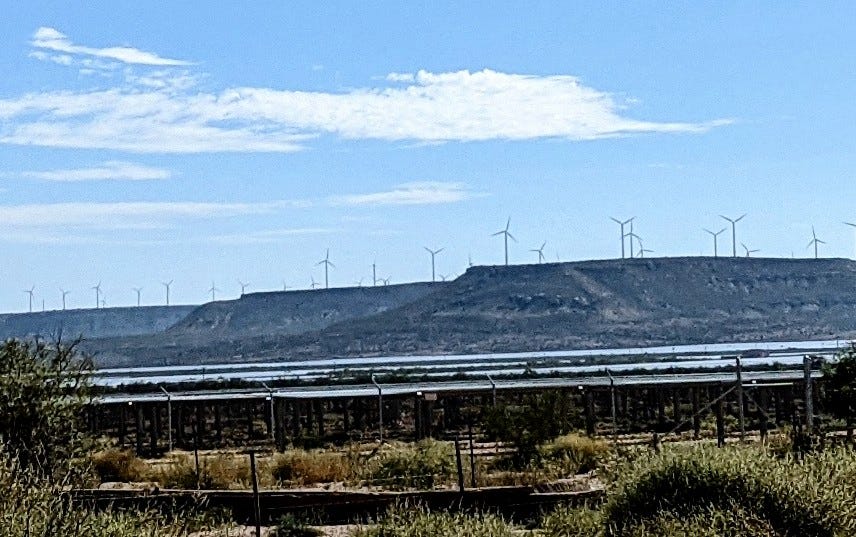
Cattle troughs, solar collectors, and wind turbines, southwest of McCamey, Texas. Maybe next time I am through there, I will get a picture that also shows a few score oil pumpjacks.
As a West Texan, I’m always aware of the price per barrel of West Texas Intermediate petroleum—$63.78, up nearly three percent today. A year ago the price was staying in the 80s.
The White House has been pushing simultaneously for low gas prices at the pump; United States energy self-sufficiency, if not dominance; and the end of subsidies for energy alternatives to hydrocarbons. At least one of these efforts will win a red “Just Kidding” hat. At this point, it looks like the drill-baby push is the one to fail. With the profit incentive fading away, drilling has slowed.
A low-grade capitalist like me thinks there is a “fair” price for oil. I remember conversations with my brother-in-law, Bill Heisler, the CEO of a very private independent oil company in Houston in the early 2000s. He suggested that they would start drilling again when crude reached $60 /barrel. And that $80 or $90 would be a boom. I asked, “Would that be fair?”
“Fairness is irrelevant,” Bill answered. “It’s a market price.” In July of 2008 WTI soared close to $150.
Despite sudden kicks up or down, the consumer prices for gasoline at the pump stays steady over time, adjusted for inflation. Here’s a chart.
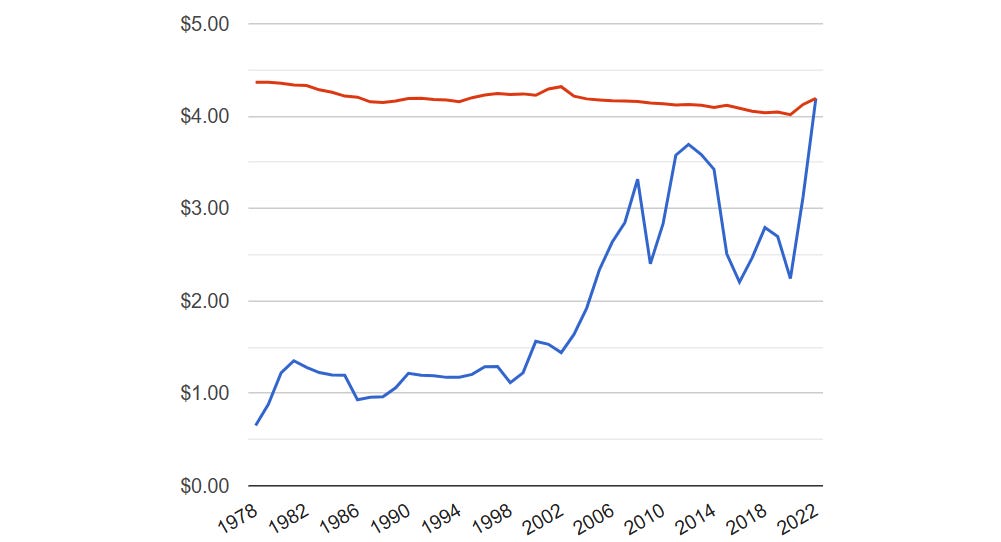
Gas prices (blue). Adjusted for inflation (red).
Source: US Inflation Calculator
That’s the market correcting itself.
It’s supply and demand. If the tariff recession kicks in, demand will go down, and the oil companies and banks will have even less reason to drill, baby. If the economy holds, we can expect the price of oil to climb again. The shut-down of off-shore drilling, and the end of incentives for solar and wind power, will reduce supply. And prices will continue to go up. My thinking is not adjusted for inflation, and the prices already seem high.
A few years ago, driving southwest of the giant fracking oilfieldsin the south side of the Permian Basin, I was struck with the fields of solar collectors. Square miles of glass panels. And above them on the bluff, a row of tall wind power turbines. Hundreds of steel towers.
What is the use for all this electricity? Dallas is 350 miles to the northeast, and a lot of volts are lost along the way. I asked an oil man in Midland, “What’s the use of all that alternative power?”
He said, “Well, the oilfield, of course.”
Energy links
A roundup of energy policy contradictions
https://www.washingtonpost.com/business/2025/05/10/oil-price-energy-tariffs-trump/
Trillions in US investments by the Arab countries
https://www.dw.com/en/as-oil-prices-fall-can-gulf-big-spenders-keep-trump-pledges/a-72440718
Why the Saudis are producing more, despite low prices
https://www.ft.com/content/2ee02b71-320b-4ecd-9494-be2cd5a31622
The big delay in new electric power plants: Turbines